


Türkiye has one of the lowest female employment rates in the OECD. For many women in Türkiye, the constraint is not willingness to work but whether a job fits with the daily realities of care, commuting, and household responsibilities. This matters because only one in three women aged 16–64 was employed in 2023, almost half the OECD average of 63% (OECD, 2024a; OECD, 2024b). Remote and hybrid work will not close this gap on their own, but they can loosen the constraints that hold women back from paid employment.
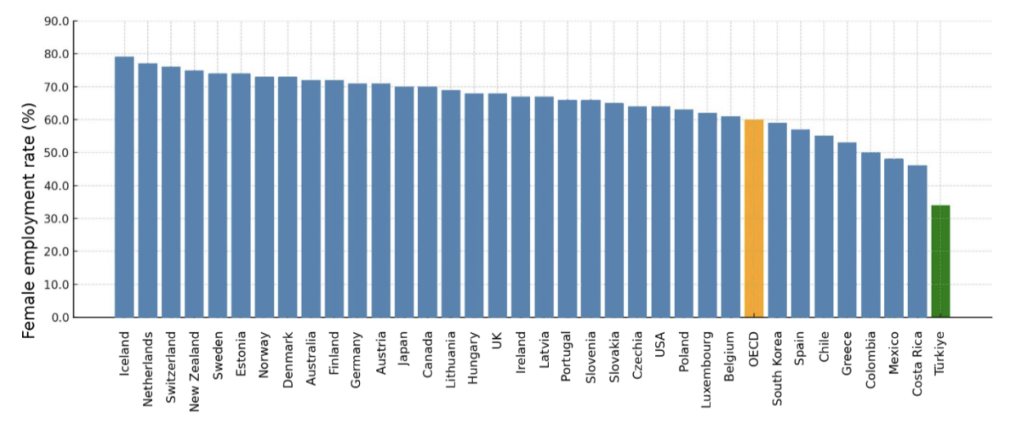
Note: Female employment rate is the share of the working-age population (16–64) who worked at least one hour for pay in the previous week. Source: OECD.
Women who enter the labour market also face weaker outcomes. Women’s unemployment stands at 14%, around five percentage points above men’s. Informal employment remains a major concern. Informality rose to around 70% in the early 2000s and still stood at 34% in 2024, leaving around one in three working women without social protection. These outcomes are shaped by regional economic structures, urban form, and socio-cultural norms. Limited access to affordable childcare remains a binding constraint for many households.
What the evidence says
Hybrid work became a stable feature of work organisation after the pandemic. In a study covering 31 European countries, we found that workers increasingly split time between home and the office in the post-pandemic period (Özgüzel, Luca and Wei, 2023). Türkiye still stands below the global average. The 2025 Global Survey of Working Arrangements reports 0.9 work-from-home days per week in Türkiye, compared with a 1.2 day world average. By contrast, Canada reports 1.9 and the United States reports 1.8. This gap signals room to expand, at least in sectors where job tasks allow it.
Figure 2: Türkiye is below the world average, with 0.9 days of remote work per week
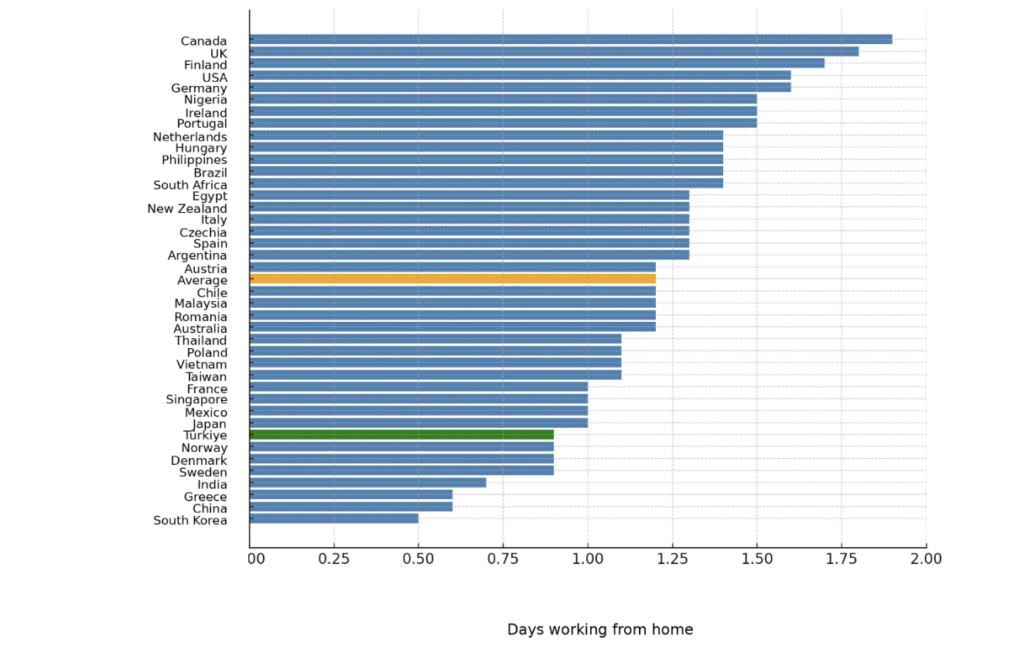
Note: Based on responses to the question “Did you work six hours or more each day last week? If so, where?” University graduates only. Source: Global Survey of Working Arrangements (2025), prepared by Cevat Giray Aksoy, Jose Barrero, Nick Bloom, Steve Davis, Mathias Dolls and Pablo Zarate. https://wfhresearch.com/gswadata/
Remote work can affect women’s employment through several channels. Greater flexibility can influence labour supply decisions, especially among mothers. Remote options can lower barriers to entry in households where mobility constraints job searches. In large cities, hybrid schedules can ease the commuting burden. In many cases, women may save around 1.5 hours per day, potentially tipping the balance towards of full-time work.
Reaching women through remote work: Case of TEMPO
TEMPO, a large customer-service provider in Türkiye, offers a clear example of how remote work can widen the hiring pool and change workforce composition. Before Covid-19, TEMPO operated through physical offices in seven provinces. During the pandemic, it moved operations to remote work at scale. We partnered with the firm to study how the move from office-based work to remote operations affected workforce outcomes and operational performance, using detailed administrative data (Aksoy et al., 2025).
We find that the share of women rose from around 50% at the start of 2020 to 75% by 2023. The share of married women increased from 5% to 12%. These shifts are significant because they point to a segment of the labour force that many firms struggle to reach under standard on-site models. Remote work also widened where the firm could hire. During the same period, the share of employees living outside major cities rose from 5% to 20%, while the share of university graduates increased from 30% to 42%. Over the same period, women’s employment in Türkiye’s South-East Anatolia region remained broadly flat at around 18–20%, suggesting that TEMPO’s change did not simply reflect local labour market trends.
From a business perspective, the case highlights three practical mechanisms. First, remote work reduces geographic constraints, easing recruitment in tight labour markets. Second, it can make jobs compatible with family responsibilities, supporting women’s entry and retention. Third, it can help firms reach educated talent outside the main urban hubs. None of this is automatic. It depends on job design, supervision, and investment in systems that keep quality and performance measurable in remote settings.
The role of the private sector and policy
Firms will determine whether remote and hybrid work translates into higher women’s employment at scale, while policy can lower the cost of adoption (OECD, 2024b). A practical agenda rests on three pillars.
First, firms should integrate hybrid work into their core workforce strategy, with clear task allocation and performance expectations. Second, they should invest in secure digital infrastructure and managerial capability, strengthening supervisor training and structured onboarding. Third, they should support work–life balance through predictable scheduling, transparent career, and return-to-work pathways. Partnerships with İŞKUR, local authorities, and training providers can help build robust talent pipelines for women outside major cities.
The government can reinforce these efforts by providingthrough targeted support for remote-work infrastructure, skills programs that broaden access to remote-friendly roles, and childcare and care support aligned with hybrid schedules. Clear labour regulations, stronger cybersecurity and data protections, and safeguards for collective representation can further build trust and encourage take-up.
Remote and hybrid work are not a silver bullet for gender gaps, but with the right firm practices and policy support, they can unlock access to jobs and strengthen Türkiye’s human capital.
References
Aksoy, C.G., Bloom, N., Davis, S.J., Marino, V. and Özgüzel, C. (2025), Remote work, employee mix, and performance, NBER Working Paper No. 33851, National Bureau of Economic Research, Cambridge, MA.
OECD (2024a), OECD Employment Outlook 2024: The Net-Zero Transition and the Labour Market, OECD Publishing, Paris, https://doi.org/10.1787/ac8b3538-en.
OECD (2024b), Job Creation and Local Economic Development 2024: The Geography of Generative AI, OECD Publishing, Paris, https://doi.org/10.1787/21db61c1-en.
Özgüzel, C., Luca, D. and Wei, Z. (2023), “The new geography of remote jobs? Evidence from Europe”, OECD Regional Development Papers, No. 57, OECD Publishing, Paris, https://doi.org/10.1787/29f94cd0-en.