

Prof. Gökhan Özertan, Dean of the Faculty of Applied Sciences, argues that the agricultural sector must undergo a profound transformation to address the climate crisis, resource constraints, and rising global food demand. His article examines how AI-driven decision-support systems, early-warning mechanisms, and data-driven production models can contribute to building a more resilient and sustainable food system. The analysis highlights that digital transformation in agriculture requires not only technological but also broader economic, environmental, and institutional restructuring.
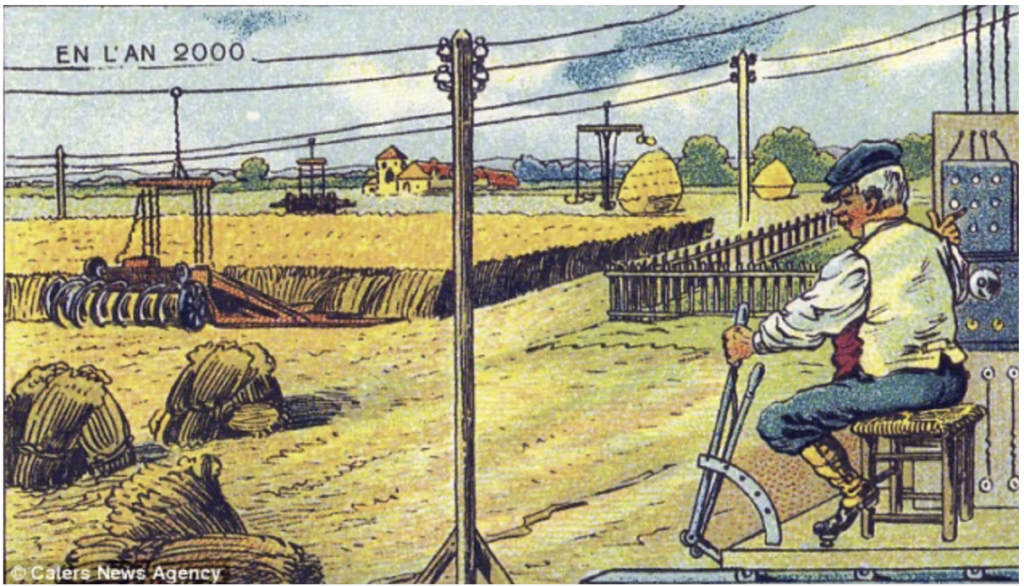
At the turn of the 20th century, the French illustrator Jean-Marc Côté imagined the farmer of the year 2000 as someone seated at the edge of his field, operating agricultural machinery through interconnected mechanical devices. His vision reflected the growing technological optimism of the era. Around the same period, roughly a century after the widespread adoption of coal during the Industrial Revolution, atmospheric CO₂ concentrations began to rise above natural levels. With accelerating industrialization and expanding economic activity, human-induced climate change emerged, gradually affecting ecosystems and living organisms across the planet.
Fast forward to the 2020s, a decade in which even keeping pace with global developments has become increasingly difficult. Beyond geopolitical tensions, public health crises, economic disruptions associated with globalization, and rapid social transformations, environmental degradation and the escalating climate crisis have rendered both sustainability and the global order increasingly fragile. Together, these dynamics have generated a wide range of interconnected risks.
Against this backdrop, ensuring that a steadily growing global population has access to sufficient, safe, and nutritious food has become more critical than ever. These challenges affect not only human societies but all living organisms on Earth. Addressing such profound uncertainty requires policies that promote the sustainable use of limited natural resources and strengthen resilience across ecological and economic systems. Yet, paradoxically, the very conditions that demand long-term planning also make forecasting and strategic decision-making increasingly complex.
The agricultural sector, confronted with rising global food demand, population pressures, environmental degradation, resource constraints, and, most notably, the climate crisis, continues to rely on traditional, labor-intensive, and resource-intensive practices in many regions. These conventional farming methods often struggle to respond effectively to mounting pressures and to overcome structural challenges such as high input costs. Limited mechanization and the persistence of traditional production techniques, for a variety of economic and institutional reasons, contribute to low productivity and inefficient resource use.
The imperative for environmentally sustainable production and responsible resource use, combined with the predominance of small-scale family farms globally, and particularly in Türkiye, underscores the structural vulnerabilities of the agricultural sector. These challenges are further intensified by the disproportionate impact of the climate crisis on agriculture; the practical difficulties of collecting reliable data in the field; persistent inefficiencies in price formation and market functioning that harm both producers and consumers; and the increasing need for robust early-warning and decision-support systems to manage shocks and uncertainty. Taken together, these factors point to the necessity of a fundamental transformation of agricultural and agri-food systems.
AI-powered technologies can enhance resource optimization by processing large volumes of data and generating actionable insights. They support farmers through advanced decision-support systems, promote inclusive and data-driven solutions, improve energy efficiency, and facilitate strategic planning at the sectoral level. By strengthening resource efficiency, these technologies can also significantly contribute to the effective implementation of policy objectives. Moreover, autonomous systems have the potential to reduce labor costs in production, minimize waste in consumption, and lower supply chain expenses through improved inventory management and optimized storage practices.
Within this transformation agenda, strengthening digital and physical infrastructure, establishing clear regulatory frameworks for data governance, and incentivizing farmers to adopt new technologies are critical priorities. Effective policy design must integrate economic, environmental, social, legal, and institutional dimensions alongside technological considerations, an inherently complex and demanding undertaking. As in other sectors, collaboration among ecosystem actors and supply chain stakeholders, through the sharing of knowledge, capabilities, and resources, along with transparency and coordinated implementation, is essential for policy success. For Türkiye to enhance its position in global competition, technology-driven policies centered on a holistic food systems approach are expected to generate substantial and sustainable gains for the sector.